Covered by Japanese public insurance — head and neck malignancies (excluding squamous cell carcinoma of the oral cavity, pharynx and larynx) since 2018 Treatment results reported from Nagoya, Japan (62 patients) and Florida, US (143 patients)
Proton therapy for sinonasal cancer is designed to concentrate radiation on cancers of the nasal cavity and paranasal sinuses, which border the eyes, optic nerves and brain, while reducing the dose to nearby structures. At Nagoya City University West Medical Center in Japan, 62 patients, most with stage 3 or 4 disease, achieved a 2-year local control rate of 92% and a 2-year overall survival rate of 76%. In Japan, sinonasal cancers have been covered by public insurance for proton therapy since 2018. This article summarizes who it suits, treatment results, side-effect care and how to receive it in Japan, based on international sources.
The eyes and brain sit right behind the nose
The nasal cavity and paranasal sinuses are air spaces in the middle of the face, with the brain directly above and the eyes and optic nerves on either side. Cancers here are often large when found, so the central challenge is to give the tumor a high radiation dose while protecting vision and the brain.
Conventional radiation (X-rays) passes through the body and leaves energy behind the tumor as well. Protons release most of their energy at a set depth and then stop (the Bragg peak). MD Anderson Cancer Center explains that proton therapy can deliver radiation to complex tumors while limiting the dose to the eyes, mouth and brain, helping to preserve vision, smell and taste.
Which head and neck cancer patients are candidates?
Proton therapy is mainly considered when the cancer is confined to the head and neck and has not spread to distant organs. Sinonasal cancers come in many histologies (cell types); those most often included in proton therapy studies are:
- Mucosal melanoma — melanoma arising in the nasal lining, the most common type (35%) in the Nagoya study.
- Squamous cell carcinoma — a common sinonasal cancer; in Japan, when it arises in the nasal cavity or sinuses, it falls within insurance coverage.
- Adenoid cystic carcinoma — a salivary-type cancer that tends to spread along nerves.
- Olfactory neuroblastoma — a rare cancer arising from the nerve tissue responsible for smell.
Proton therapy is given both after surgery to prevent recurrence and as the main treatment when surgery is difficult. Salivary gland cancers and skull-base tumors are also frequently considered for proton therapy for the same reasons.
Treatment results from Nagoya, Japan and Florida, US
The Proton Therapy Center at Nagoya City University West Medical Center reported results for 62 patients with sinonasal cancer treated with spot scanning proton therapy (which paints the dose with a narrow beam, spot by spot) between May 2014 and September 2019, in the International Journal of Particle Therapy in 2021. Ninety-five percent of patients had stage 3 or 4 disease, and median follow-up was 17 months.
The University of Florida published long-term results for 143 patients with nonmetastatic sinonasal cancer, followed for up to 12.5 years, in the same journal. Ninety percent had stage 3 or 4 disease, and 82% received proton therapy after surgery.
| Outcome | Nagoya, Japan (62) | Florida, US (143) |
|---|---|---|
| Local control | 92% at 2 years | 80% at 5 years |
| Overall survival | 76% at 2 years | 59% at 5 years |
| Neck lymph node control | Not reported | 96% at 5 years |
| Late side effects grade 3 or higher | 19% | 22% |
Sources: Nakajima K, et al. Int J Part Ther 2021;8(1):189–199. Dagan R, et al. Int J Part Ther 2021;8(1):200–212. Local control is the share of patients whose cancer did not regrow at the treated site.
The Nagoya team concluded that the treatment was well tolerated with good local control and could be a leading treatment option for sinonasal cancer. Survival was especially high in patients with adenoid cystic carcinoma and olfactory neuroblastoma. In the Florida study, patients whose visible tumor was fully removed by surgery before proton therapy had a better 5-year local control rate of 87%, and local control was closely linked to long-term survival.
Across head and neck cancer more broadly, a US phase 3 trial of 440 patients with oropharyngeal (tonsil and base-of-tongue) cancer published in The Lancet also found that proton therapy controlled the cancer as well as intensity-modulated radiotherapy (IMRT) while reducing swallowing side effects.
Side effects and how they are managed
Proton therapy is still radiotherapy, so symptoms do occur in the treated area. MD Anderson lists skin irritation, mouth sores and sore throat, dry mouth, fatigue and weight loss as common. Symptoms can continue or increase for 2–3 weeks after treatment ends and usually heal over 4–6 weeks.
- Eyes — of 16 late side effects of grade 3 or higher in the Nagoya study, 11 involved vision, most commonly cataract. Cataract can be corrected with surgery, so regular eye checks after treatment are advisable.
- Brain — the Florida study reported brain tissue necrosis in 6% of patients. Regular MRI scans are used to monitor this after treatment.
- Mouth and skin — brush with a soft toothbrush after meals and at bedtime, and rinse with a baking soda and salt solution 4–6 times a day. Wash skin with mild soap and apply an unscented moisturizer from day one.
- Eating — choose soft, moist foods, and limit spicy or acidic foods and fizzy drinks.
In the Nagoya study there was one grade 4 side effect and no treatment-related deaths. Given how many patients had advanced cancer, the investigators judged the safety to be acceptable.
Treatment steps and duration
- Consultation and record review — biopsy results and CT, MRI and PET images are used to confirm the histology, stage and any spread toward the eyes or brain.
- Deciding on surgery — together with the ENT team, doctors decide whether to operate first or use proton therapy as the main treatment.
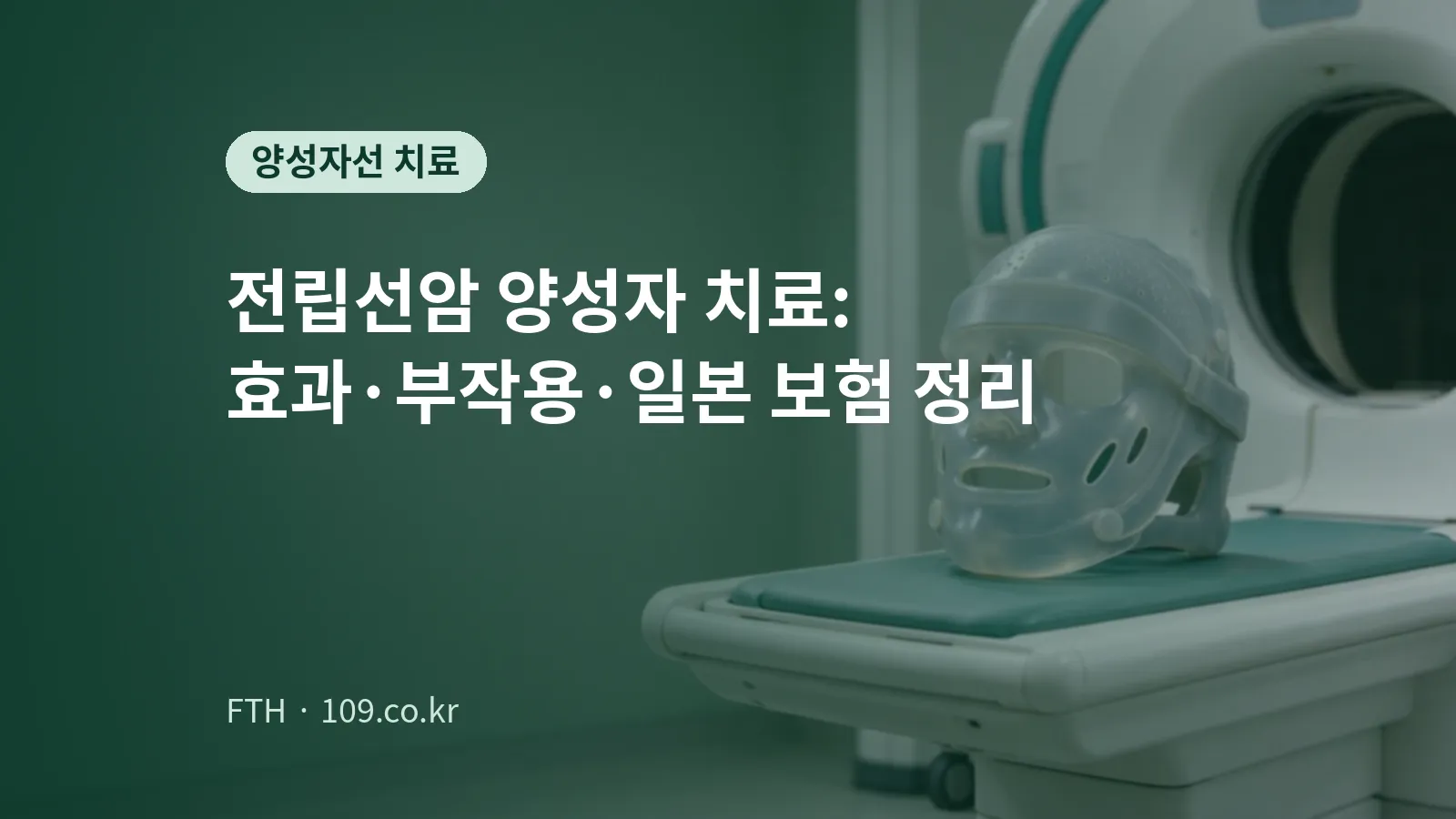
- Immobilization mask and planning — a mask fitted to the face keeps you in the same position every day, and CT and MRI are combined to design beam angles that avoid the eyes and optic nerves.
- Daily treatment — outpatient visits five days a week. In the Nagoya study, most patients received 70.2 Gy in 26 fractions over about five weeks, while mucosal melanoma was treated with 60 Gy in 15 fractions over about three weeks.
- Follow-up — regular MRI and endoscopy, along with eye examinations.
Each session takes longer to position you in the mask than to deliver the beam, so a hospital visit usually lasts about an hour. Step-by-step details are in the proton therapy process and duration.
How to receive sinonasal proton therapy in Japan
A January 2018 document from the Advanced Medical Care Council of Japan's Ministry of Health, Labour and Welfare set "head and neck malignancies (excluding squamous cell carcinoma of the oral cavity, pharynx and larynx)" as an insured indication for proton therapy, and public insurance has applied since April 2018. Because only squamous cell carcinoma of the mouth, pharynx and larynx is excluded, sinonasal cancers, including squamous cell carcinoma, fall within coverage. Mucosal melanoma, adenoid cystic carcinoma, olfactory neuroblastoma, salivary gland cancer and skull-base tumors are also included.
Patients living abroad without Japanese public insurance pay for proton therapy, tests and hospital stays as self-pay care, so ask the hospital for a separate estimate. For the difference between insurance, Advanced Medical Care and self-pay care, see proton therapy information in Japan; for head and neck cancer information in Japan, see head and neck cancer medical information.
Before a consultation, gather the pathology report (with the histology name), CT, MRI and PET images (original discs), details and dates of any surgery and chemotherapy, records of previous radiotherapy and recent eye test results to speed things up.
Points to check and questions for your doctor
- Given the histology and stage of my cancer, would proton therapy offer more benefit than conventional radiation?
- Should I have surgery first, or proton therapy as the main treatment?
- My cancer is close to the eye or optic nerve; what effect on vision should I expect?
- Will I receive chemotherapy at the same time? How many sessions and weeks will treatment take?
- When and where should I have MRI scans and eye checks after treatment?
Frequently asked questions
How effective is proton therapy for sinonasal cancer?
In the 62-patient study at Nagoya City University West Medical Center, the 2-year local control rate was 92% and 2-year overall survival 76%. In the University of Florida study of 143 patients, 5-year local control was 80%, rising to 87% when all visible cancer had been removed by surgery first.
Is head and neck proton therapy covered by insurance in Japan?
Head and neck malignancies have been covered by public insurance since April 2018. Only squamous cell carcinoma of the mouth, pharynx and larynx is excluded, so sinonasal cancer, salivary gland cancer and skull-base tumors can be treated under insurance.
What are the side effects of proton therapy for sinonasal cancer?
During treatment, skin irritation, mouth soreness and fatigue are common and usually settle 4–6 weeks after treatment. Late eye problems such as cataract have been reported, so regular eye checks follow treatment.
How many sessions does sinonasal proton therapy take?
It depends on the histology and institution. In the Nagoya study, most patients had 26 sessions (about five weeks), and mucosal melanoma was treated in 15 sessions (about three weeks).
Related: Proton therapy for esophageal cancer · Head and neck photoimmunotherapy results · Petosemtamab for head and neck cancer
Sources
- Nakajima K, Iwata H, Hattori Y, et al. Spot scanning proton therapy for sinonasal malignant tumors. Int J Part Ther 2021;8(1):189–199
doi.org/10.14338/IJPT-D-20-00043.1
Checked: 2026-11-03 - Dagan R, Uezono H, Bryant C, et al. Long-term outcomes from proton therapy for sinonasal cancers. Int J Part Ther 2021;8(1):200–212
doi.org/10.14338/IJPT-20-00068.1
Checked: 2026-11-03 - Frank SJ, et al. Proton versus photon radiotherapy for patients with oropharyngeal cancer in the USA: a multicentre, randomised, open-label, non-inferiority phase 3 trial. The Lancet — The ASCO Post (January 2026)
ascopost.com
Checked: 2026-11-03 - MD Anderson Cancer Center — Proton therapy for head and neck cancers
mdanderson.org
Checked: 2026-11-03 - Ministry of Health, Labour and Welfare (Japan), Advanced Medical Care Council — Handling of particle beam therapy (January 2018) (Japanese)
mhlw.go.jp
Checked: 2026-11-03
Written by the FTH editorial team. Sources checked 2026-11-03 · Medical review: not applicable
This article is general information based on public sources and does not replace diagnosis or treatment. Please discuss treatment decisions with your medical team.