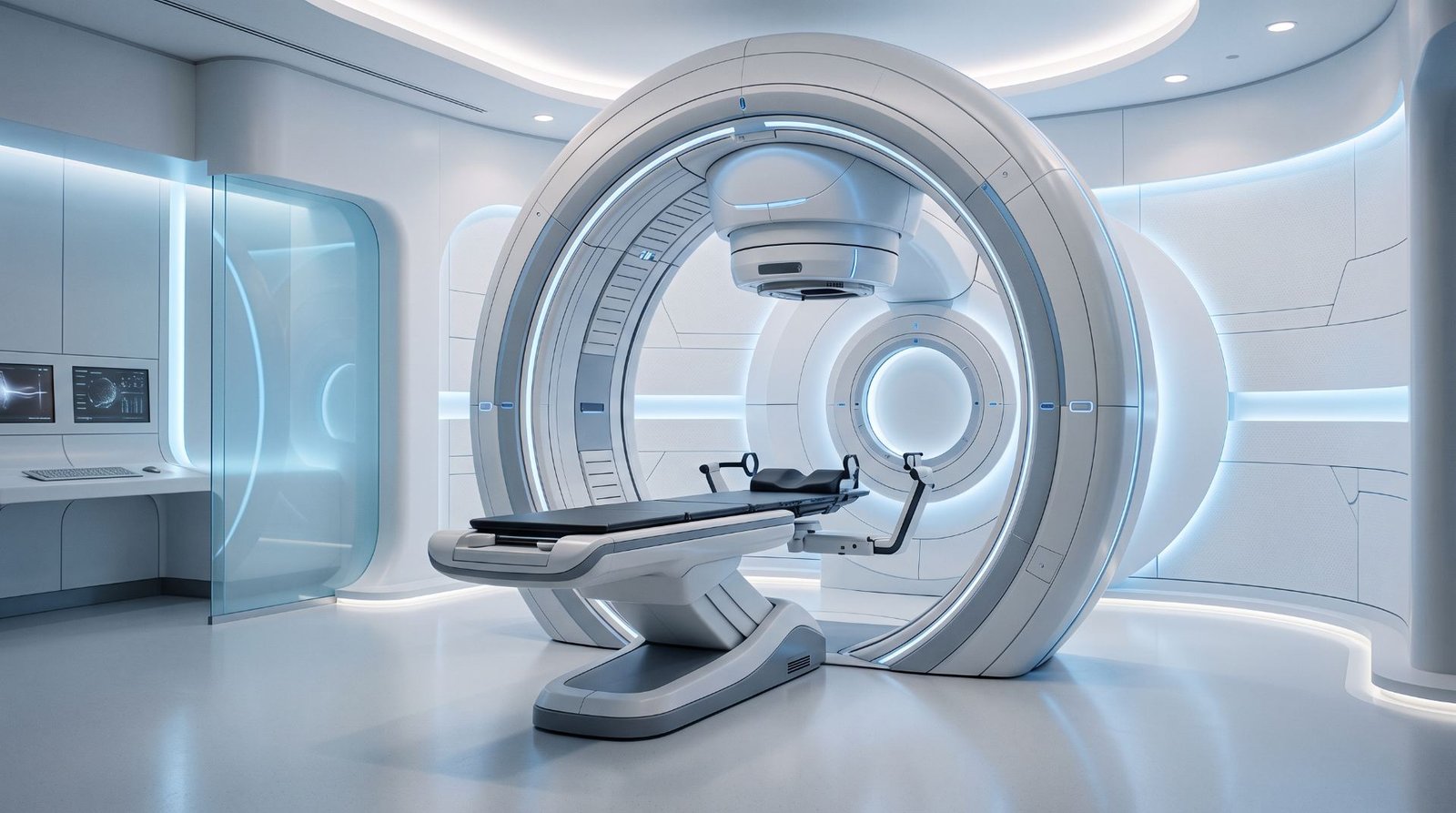
Basic concepts of proton therapy, Japan’s public insurance coverage, and the equipment and care system published by the designated institution.
Illustrative image
Summary
Proton therapy is a type of radiation therapy. In Japan, public health insurance covers it for certain conditions, and some other conditions are treated under the Advanced Medical Care (Senshin Iryo) system. This page separates what the Proton Therapy Center at Chubu International Medical Center (Gifu) publishes from information in public medical institution sources.
Key terms and basic concepts
A proton beam is a particle beam made by accelerating hydrogen nuclei (protons). X-rays weaken gradually as they pass through the body, whereas protons are described as releasing most of their energy at a set depth and then stopping (the Bragg peak).
Intensity-modulated proton therapy (IMPT) adjusts beam intensity and distribution to match the shape of the tumour.
Whether proton therapy is an option, and how it compares with other radiation, surgery or drug therapy, depends on stage and site and is decided by the medical team.
Method as described in the source (institution’s public materials)
Institution’s description
Equipment: the center states that it uses Varian’s ProBeam360°.
The center’s menu includes intensity-modulated proton therapy and an introduction to multidisciplinary treatment combining other therapies.
Consultations are by appointment only; eligible cancers, fees and treatment flow are on separate pages of the center’s site.
The center’s site offers English and Chinese (Simplified and Traditional) pages in addition to Japanese.
What to confirm with the medical team
Whether the diagnosis, stage and tumour site fall within the center’s eligible conditions
Whether it is covered by public insurance, Advanced Medical Care, or self-pay
Imaging, pathology records and referral letter format required in advance
Treatment period, visit schedule and length of stay
Whether and how other treatments (e.g. chemotherapy) would be combined or scheduled
Limitations, risks and precautions
Protons are still radiation; side effects can occur depending on the treated area, and their type and severity vary by person and site.
Public institution sources note that, depending on the condition, other radiation or drug therapies may be recommended first.
FTH does not evaluate the merits of any equipment or institution. Equipment details are restated from what the institution publishes.
Regulatory, approval and cost information
Item
Details
Japanese public insurance
Authoritative source Coverage began with paediatric tumours in 2016 and expanded in 2018, 2022 and 2024. As of June 2024: localized paediatric solid tumours; bone and soft-tissue tumours difficult to treat surgically; head and neck malignancies (excluding squamous cell carcinoma of the oral cavity, pharynx and larynx); localized and locally advanced prostate cancer; hepatocellular carcinoma ≥4 cm; intrahepatic cholangiocarcinoma; locally advanced pancreatic cancer; postoperative local recurrence of colorectal cancer; unresectable stage I–IIA early lung cancer (some only where curative surgery is difficult).
Advanced Medical Care
Authoritative source Some conditions not covered by insurance are treated as Advanced Medical Care. Eligibility and cost must be confirmed per institution and condition.
Revisions in 2026
Not confirmed Changes after the 2024 revision were not confirmed in this check.
Fees at the designated institution
Not confirmed The center’s fee page was outside the scope of this check; please confirm directly with the institution.
Equipment and staff
Institution’s description Check equipment and staff details, such as the use of ProBeam360°, directly on the institution’s site.
Questions to ask the medical team
Is proton therapy worth considering for my diagnosis and stage?
Would it fall under public insurance, Advanced Medical Care, or self-pay?
What differences can be expected compared with X-ray therapy or other options?
What side effects are expected, and what is the follow-up schedule?
What documents and procedures are needed for patients living abroad?
External medical institutions are shown only as information sources; nothing on this site is an advertisement for, or recommendation of, any institution or treatment.
FTH is not a medical institution; it is a company that provides guidance on overseas medical information, translation, and on-site interpretation support. The content of this site is for informational purposes only and does not constitute a diagnosis or treatment recommendation for any individual, nor a guarantee of treatment results. Please discuss the suitability, risks and decision to undergo any treatment with your attending medical team.
Proton therapy in Japan falls under public insurance, Advanced Medical Care or self-pay depending on the condition. Here is what to distinguish before reading institutional information.
Need translation or interpretation related to this information?
We can confirm the scope of source-document translation and interpretation for clinic visits. Treatment suitability is decided by the attending medical team.