
In clinical trials — ureteral cancer photodynamic therapy, phase 3 ENLIGHTED (NCT04620239), single arm without a control group · not yet approved for ureteral or renal pelvis cancer; the developer plans a US filing in 2027 · the same drug was approved in the EU in 2017 for low-risk prostate cancer
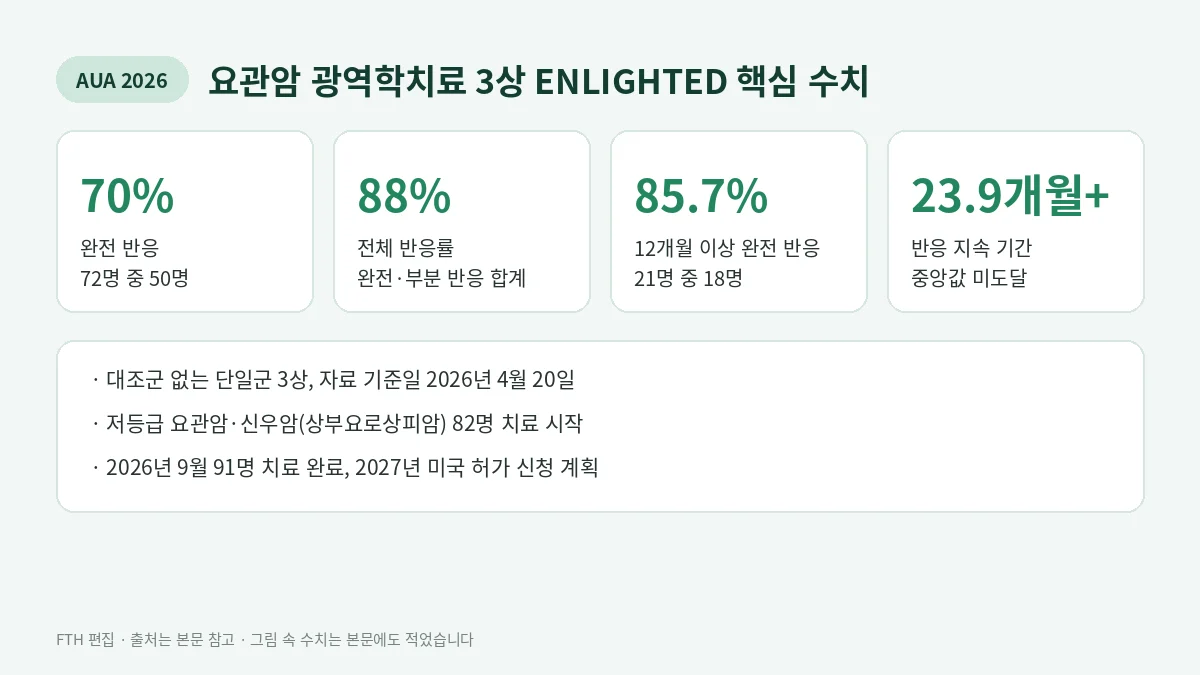
Ureteral cancer photodynamic therapy with padeliporfin vascular-targeted photodynamic therapy (VTP) showed encouraging interim phase 3 results. At the American Urological Association meeting in May 2026 (AUA 2026), 50 of 72 patients (70%) with low-grade ureteral or renal pelvis cancer had a complete response, with no visible tumor, after up to three treatments. The trial is single-arm, all 91 patients finished treatment in September 2026, and the developer is preparing a US new drug application for 2027.
What is new in ureteral cancer photodynamic therapy?
Urothelial cancer that forms in the renal pelvis (the funnel where urine collects in the kidney) or the ureter is called upper tract urothelial carcinoma (UTUC). According to the 2026 European Association of Urology (EAU) guidelines, UTUC accounts for only 5–10% of urothelial cancers, and renal pelvis tumors are about twice as common as ureteral ones. This article covers low-grade tumors.
The drug is padeliporfin (code name WST11, brand name TOOKAD). After an intravenous infusion, near-infrared light is delivered through a thin fiber passed up a ureteroscope. The light activates the drug, which produces high levels of reactive oxygen. The European Medicines Agency (EMA) explains that this destroys the vessels supplying the cancer and the cancer cells then die quickly. For how this differs from other light-based treatments, see PDT vs photoimmunotherapy.
| Item | Details |
|---|---|
| Trial | ENLIGHTED (NCT04620239), international phase 3 |
| Control group | None (single arm, open label) |
| Patients | New or recurrent low-grade, non-invasive UTUC |
| Treatment | Padeliporfin 3.66 mg/kg IV, then 10 minutes of light via ureteroscope |
| Primary endpoint | No tumor in the same-side kidney and ureter 28±3 days after induction |
| Scale | 29 sites in the US, Europe and Israel; 91 patients treated (September 2026, per the developer) |
Sources: ClinicalTrials.gov record (updated July 2026); ImPact Biotech releases (2026-05-16, 2026-09-09).
Which patients were eligible?
ENLIGHTED enrolled patients with low-grade disease who wanted to treat the tumor while keeping the kidney. Main criteria from the trial record and meeting reports:
- New or recurrent low-grade, non-invasive UTUC confirmed by central pathology
- Up to two biopsy-proven lesions, 5–15 mm in the kidney or 5–20 mm in the ureter
- No high-grade cells on instrumented urine cytology
- eGFR of 30 or more and Karnofsky performance status of 50% or more
People with prior or current upper tract carcinoma in situ, invasive T2 or higher disease within two years, or photosensitive skin disease or porphyria were excluded. The results apply to low-grade tumors; high-grade tumors follow different treatment standards.

What are the current kidney-sparing options for low-grade UTUC?
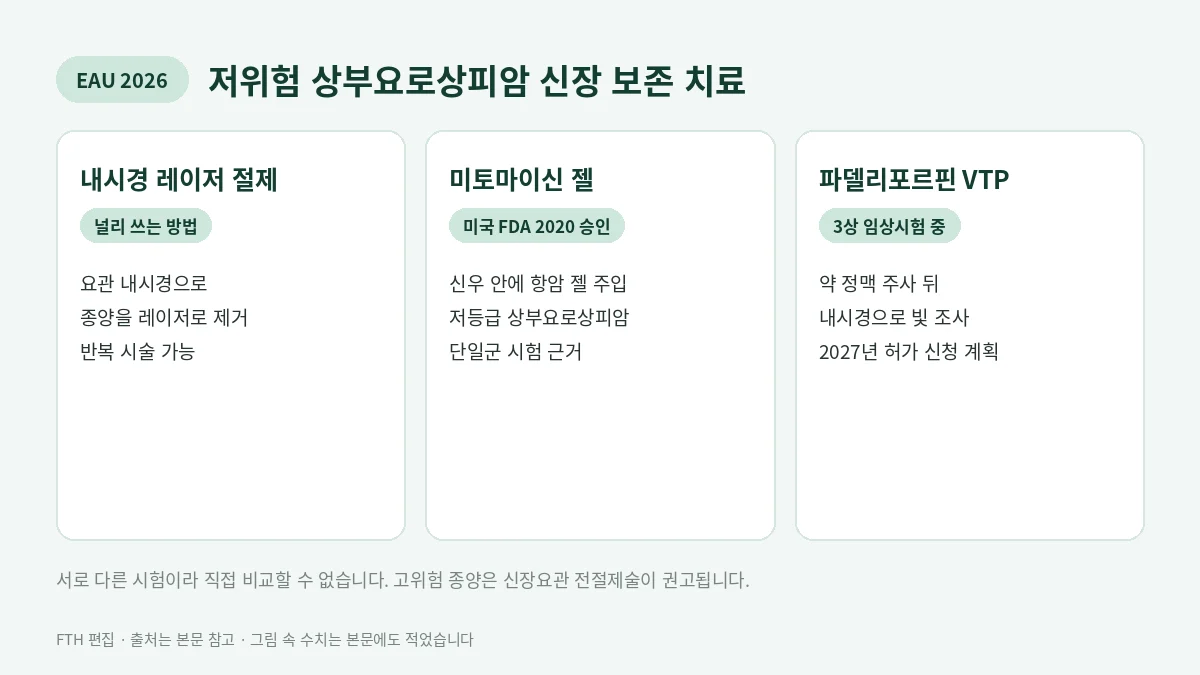
The EAU 2026 guidelines strongly recommend offering kidney-sparing management as the primary option for low-risk UTUC, and radical nephroureterectomy for high-risk disease. Endoscopic laser ablation through a ureteroscope is a widely used kidney-sparing approach.
In April 2020 the US FDA approved a mitomycin gel instilled into the renal pelvis (Jelmyto) for low-grade UTUC. In the single-arm OLYMPUS trial behind that approval, 41 of 71 patients (58%) had a complete response three months after starting treatment. Padeliporfin VTP is being studied as an additional kidney-sparing option; the two trials differ in patients and timing, so their numbers cannot be compared directly. Your urology team decides which approach fits based on tumor location, size and recurrence history.
How is padeliporfin VTP given?
Treatment is combined with ureteroscopy. The steps in the trial record and meeting reports are:
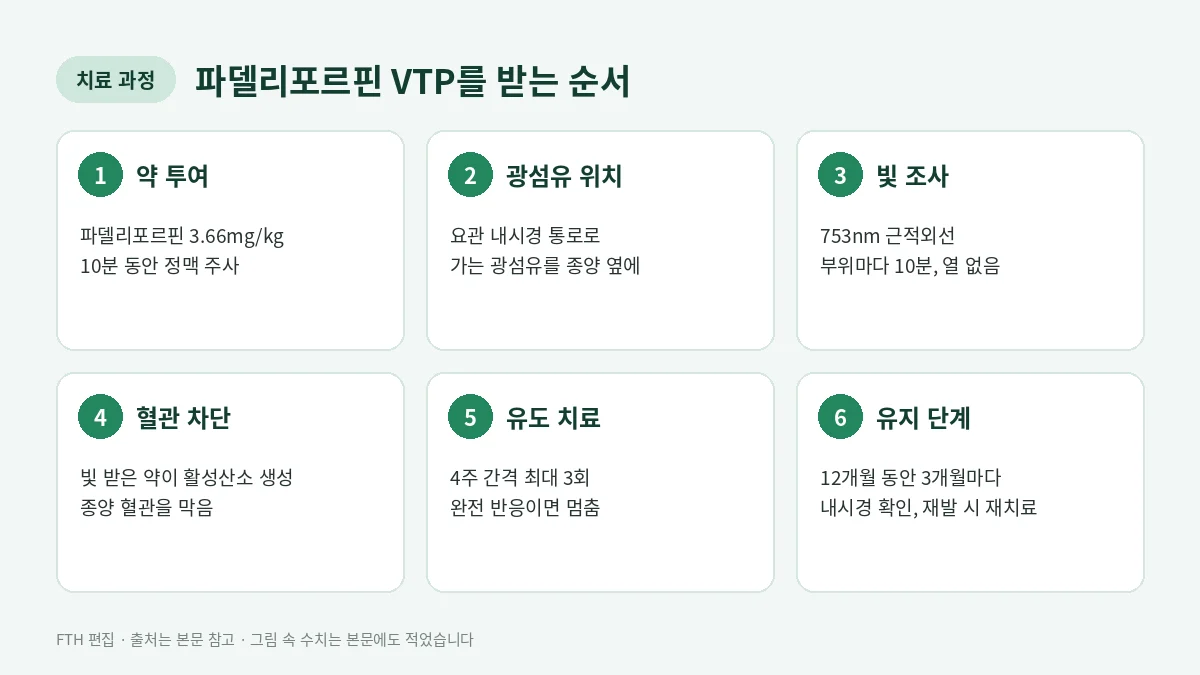
- Infusion: padeliporfin 3.66 mg/kg intravenously over 10 minutes.
- Fiber placement: a thin optical fiber is passed through the ureteroscope channel next to the tumor.
- Illumination: 753 nm near-infrared light for 10 minutes per area; the light activates the drug rather than burning tissue.
- Induction: up to three treatments 4 weeks (28±3 days) apart, stopping once a complete response is reached.
- Response check: ureteroscopy, biopsy when feasible and urine cytology 28±3 days after the last induction treatment.
- Maintenance phase: with a complete response, ureteroscopy every 3 months for 12 months, and VTP is given again if a recurrence is small enough to treat.
For prostate cancer in Europe, fibers are placed through hollow needles under general anesthesia. In ureteral cancer the light travels through an endoscope passed via the urethra and bladder, so no skin incision is needed.
What did the phase 3 results show?
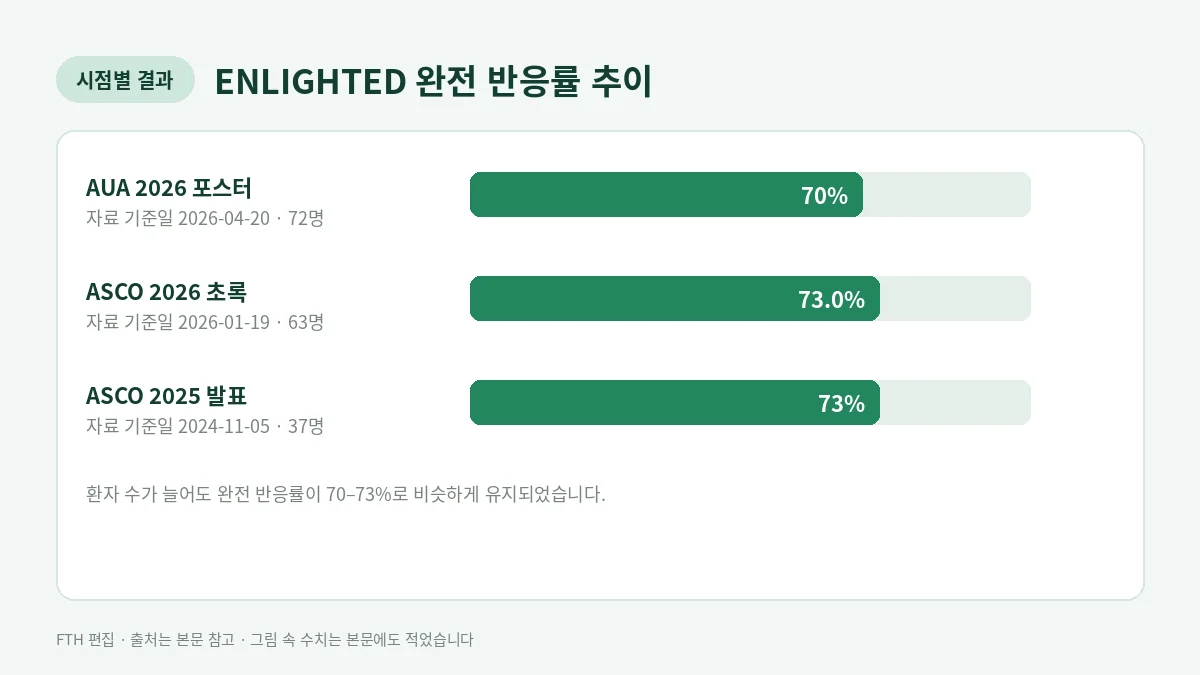
At AUA 2026 on May 16, 2026, Professor Vitaly Margulis of UT Southwestern Medical Center presented an interim analysis (data cutoff April 20, 2026): 82 patients had started treatment and 72 had completed the primary response evaluation. Of the 72, 50 (70%) had a complete response and 13 (18%) a partial response, for an overall response rate of 88%.
| Presentation (data cutoff) | Evaluated | Complete response | Partial response |
|---|---|---|---|
| AUA 2026 poster (2026-04-20) | 72 | 70% (50) | 18% (13) |
| ASCO 2026 abstract (2026-01-19) | 63 who completed induction | 73.0% | 17.7% |
| ASCO 2025, reported July 2025 (2024-11-05) | 37 | 73% | ORR 86.5% |
Sources: ImPact Biotech AUA 2026 release (2026-05-16), J Clin Oncol 44(16 suppl) TPS4643 (2026), OncLive (2025-07-08). The 2025 data are more than a year old and shown for reference.
As the analysis grew from 37 to 72 patients, the complete response rate stayed in the 70–73% range. In the phase 1 study (19 patients) from Memorial Sloan Kettering Cancer Center, published in the Journal of Urology in 2023, 9 of 18 (50%) had a complete response 30 days after the first treatment, and the final complete response rate was 68% after partial responders received a second treatment.
How long did complete responses last?
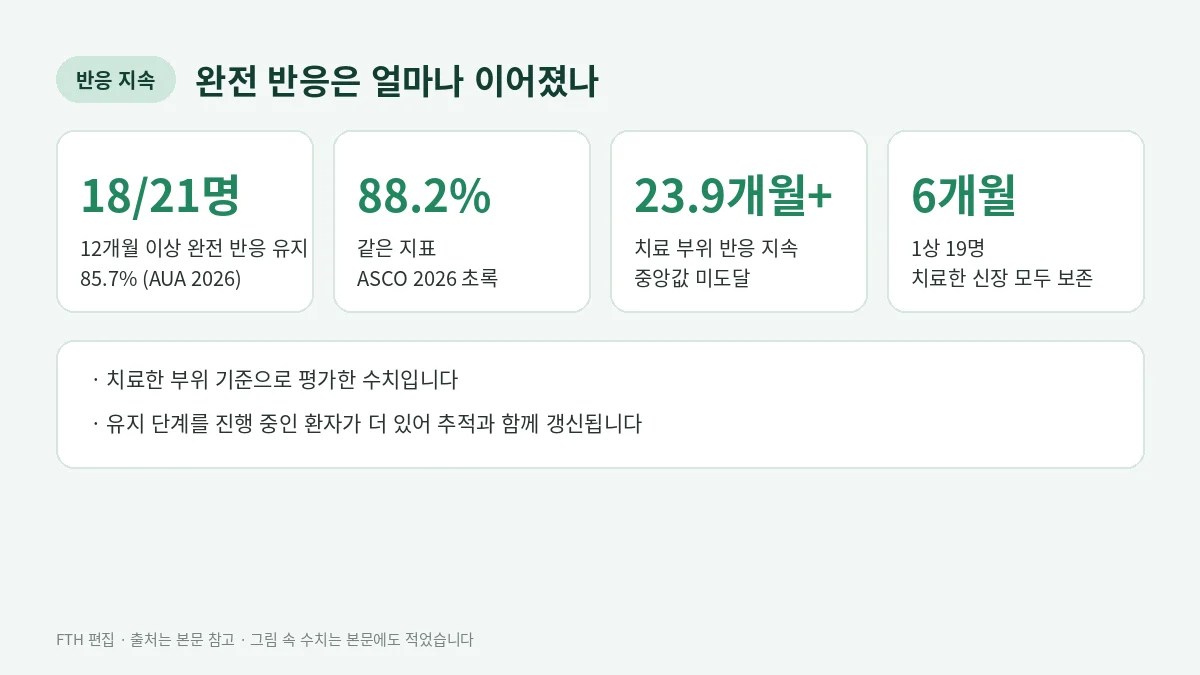
Of 21 patients who completed the maintenance phase, 18 (85.7%) kept a complete response in the treated area for at least 12 months (AUA 2026). The January cutoff in the ASCO 2026 abstract showed 88.2% on the same measure, and the median duration of response in the treated area had not been reached, at 23.9 months or longer. More patients are still in maintenance, so these numbers will be updated. The developer planned to present interim data at ESMO 2026 in October; as of November 2026 we found no newly published numbers.
What about side effects and ureteral strictures?
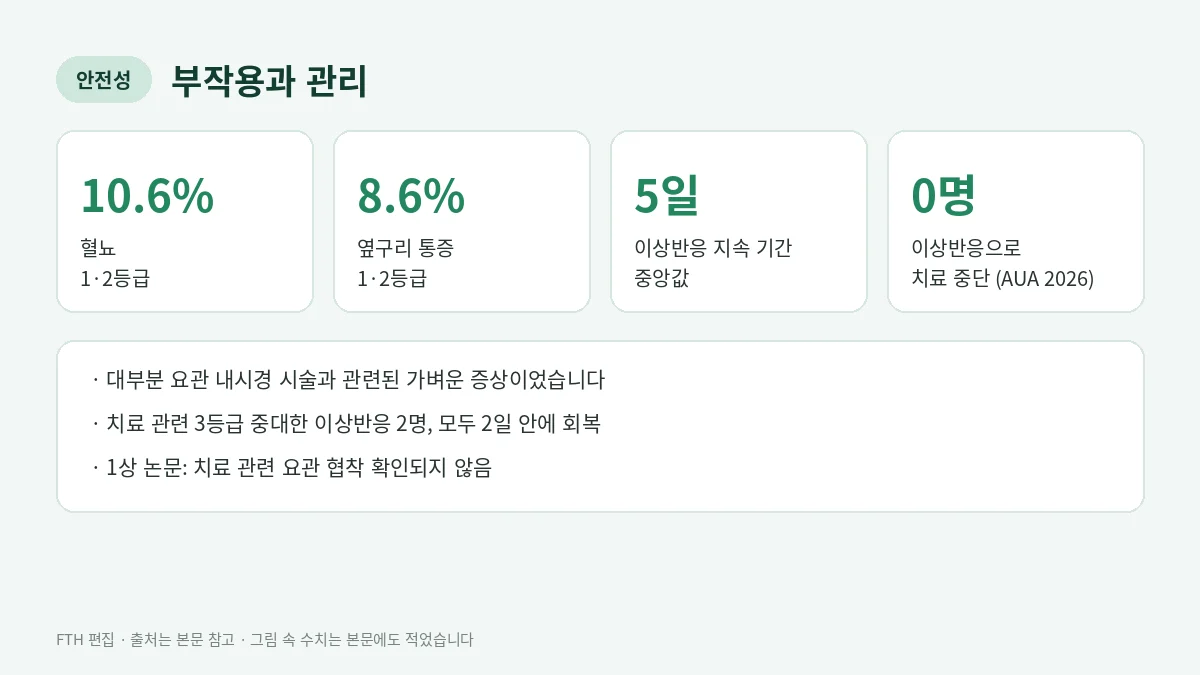
In the ASCO 2026 abstract, the most common adverse events were hematuria 10.6%, flank pain 8.6%, nausea 5.5%, procedural pain 4.5%, abdominal pain 4.1%, painful urination 4.1%, vomiting 3.4% and fatigue 3.1%, all grade 1 or 2. Their median duration was 5 days, and the AUA 2026 report described most as related to the ureteroscopic procedure.
- Treatment-related grade 3 serious events: 2 patients (AUA 2026), both resolved within 2 days; the case in the ASCO 2026 abstract was renal colic.
- Stopped treatment because of side effects: none (AUA 2026)
- All serious adverse events: 23 (7.7%), mostly judged unrelated to treatment (ASCO 2026 abstract)
On ureteral strictures, the phase 1 paper found no treatment-related strictures, and all treated kidneys were preserved at 6 months. ENLIGHTED records ureteral obstruction, stent status and eGFR at 12 months as secondary endpoints, so the final report will add detail.
Where is it available? Approval status
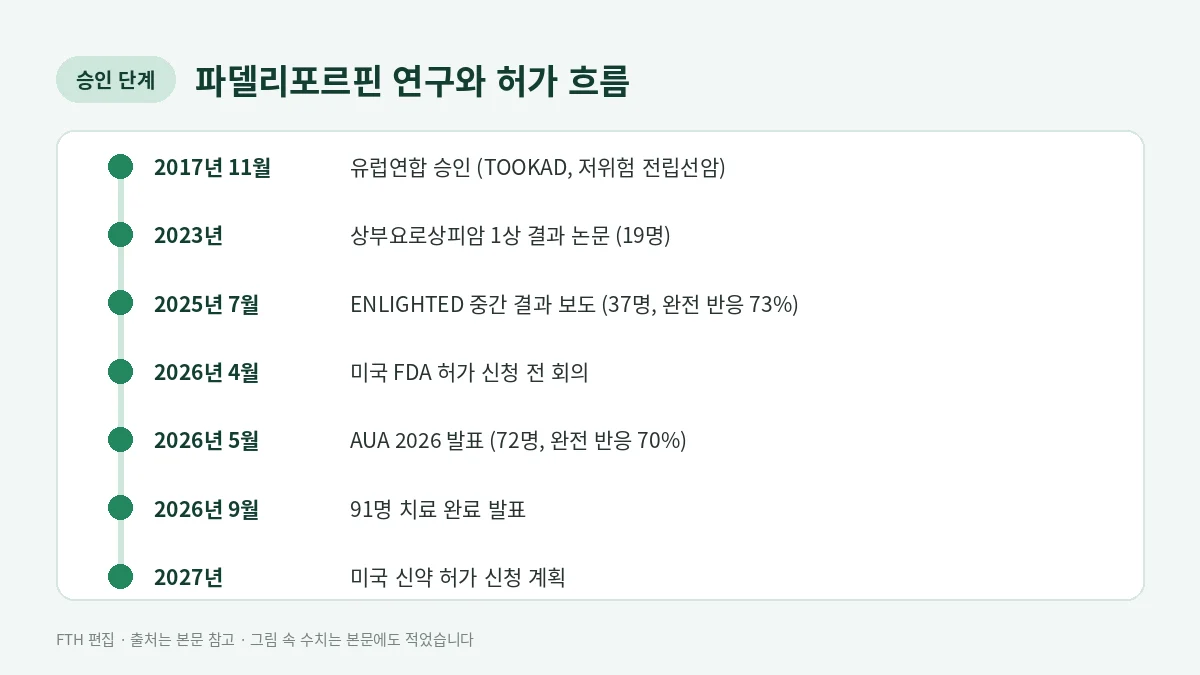
As of November 2026, padeliporfin VTP for ureteral and renal pelvis cancer is in clinical trials. On September 9, 2026 the developer reported that all 91 patients had been treated at 29 sites in the US, Europe and Israel. At an April 2026 pre-NDA meeting, the US FDA acknowledged the potential clinical value of durable complete responses in the treated area, and the company plans to file in 2027 after topline results. It is also discussing an expanded access program with the FDA for eligible US patients before a potential approval.
The same drug was approved in the European Union in November 2017 for low-risk prostate cancer, so there is existing experience in people. According to the EMA, 49% of treated patients versus 14% of untreated patients had no definite signs of cancer after 24 months in the pivotal study. Japan is not among the ENLIGHTED countries. For light-based treatment in Japan see Photoimmunotherapy information, and for approved photodynamic therapy in other cancers see basal cell carcinoma PDT and esophageal cancer PDT.
Questions for your doctor
- Is my tumor low grade or high grade? What did the biopsy and urine cytology show?
- Are the number and size of my tumors similar to the trial criteria (up to two lesions, 5–15 mm kidney or 5–20 mm ureter)?
- Which suits me: laser ablation, mitomycin gel or nephroureterectomy?
- How can I find out about the padeliporfin VTP expanded access program or related trials?
- What is my current eGFR, and is my other kidney healthy?

Frequently asked questions
Is ureteral cancer photodynamic therapy done without open surgery?
Yes. Light is delivered through an endoscope passed via the urethra and bladder into the ureter, with no skin incision. It is being studied as a kidney-sparing treatment that treats the tumor while keeping the kidney.
What does a 70% complete response mean?
It means 50 of 72 patients had no visible tumor anywhere in the same-side kidney and ureter at the post-induction evaluation, judged by ureteroscopy, biopsy when feasible and urine cytology. After that, ureteroscopy every 3 months during the maintenance phase keeps checking the result.
Can it be used for high-grade ureteral or renal pelvis cancer?
ENLIGHTED included only low-grade, non-invasive tumors. The developer has said studies in high-grade UTUC are planned or ongoing; for high-grade tumors the EAU guidelines currently recommend nephroureterectomy.
When could padeliporfin VTP be approved?
In its September 2026 release the developer said it plans to file a new drug application with the US FDA in 2027, after reporting topline results. Whether and when it is approved will depend on the FDA review.
Sources
- ImPact Biotech (company release) — ImPact Biotech presents updated data from phase 3 ENLIGHTED trial of padeliporfin VTP in LG-UTUC at AUA 2026 (2026-05-16)
biospace.com
Checked on: 2026-11-26 - Margulis V, Kaufman R Jr, Raman JD, et al. Advancing treatment of low-grade upper tract urothelial carcinoma (LG UTUC) with padeliporfin vascular-targeted photodynamic therapy (VTP): the ENLIGHTED phase 3 trial. J Clin Oncol. 2026;44(16 suppl):TPS4643
doi.org
Checked on: 2026-11-26 - ImPact Biotech (company release) — ImPact Biotech announces completion of treatment in phase 3 ENLIGHTED trial of padeliporfin VTP in LG-UTUC and positive regulatory updates (2026-09-09)
impactbiotech.com
Checked on: 2026-11-26 - Urology Times — Phase 3 trial of padeliporfin VTP completes treatment in LG-UTUC (2026-09-10)
urologytimes.com
Checked on: 2026-11-26 - OncLive — Padeliporfin vascular-targeted photodynamic therapy safely produces high response rates in low-grade upper tract urothelial cancer (2025-07-08)
onclive.com
Checked on: 2026-11-26 - OncLive — Padeliporfin VTP therapy yields complete responses with manageable safety in low-grade upper tract urothelial cancer (AUA 2025, 2025-04-29)
onclive.com
Checked on: 2026-11-26 - Yip W, Sjoberg DD, Nogueira LM, et al. Final results of a phase I trial of WST-11 (TOOKAD Soluble) vascular-targeted photodynamic therapy for upper tract urothelial carcinoma. J Urol. 2023;209(5):863-871
pmc.ncbi.nlm.nih.gov
Checked on: 2026-11-26 - ClinicalTrials.gov — NCT04620239, ENdoluminal LIGHT ActivatED Treatment of Upper Tract Urothelial Cancer (ENLIGHTED) Study
clinicaltrials.gov
Checked on: 2026-11-26 - European Medicines Agency — Tookad (padeliporfin) EPAR
ema.europa.eu
Checked on: 2026-11-26 - European Association of Urology — EAU Guidelines on Upper Urinary Tract Urothelial Cell Carcinoma 2026: Disease management
uroweb.org
Checked on: 2026-11-26 - European Association of Urology — EAU Guidelines on Upper Urinary Tract Urothelial Cell Carcinoma 2026: Epidemiology, aetiology and pathology
uroweb.org
Checked on: 2026-11-26 - The ASCO Post — FDA approves mitomycin for low-grade upper tract urothelial cancer (2020-05-10)
ascopost.com
Checked on: 2026-11-26
Written by the FTH editorial team, sources checked 2026-11-26 · Medical review: none
This article is general information based on public sources and does not replace diagnosis or treatment. Please discuss treatment decisions with your care team.